PERSONAL TRAINING
Started 30 April, Cesiones Icons Gym, Marbella → USA → Kilimanjaro, September 2025
I never thought I’d be writing a blog about training. Honestly, I used to be the person who rolled their eyes at people who talked about their workouts as if they were writing a memoir. And here I am. Writing a memoir about my workouts. So let me just say upfront — this isn’t about being fit. This isn’t about aesthetics. This started, very simply, because I had to change something. My health left me no other choice.
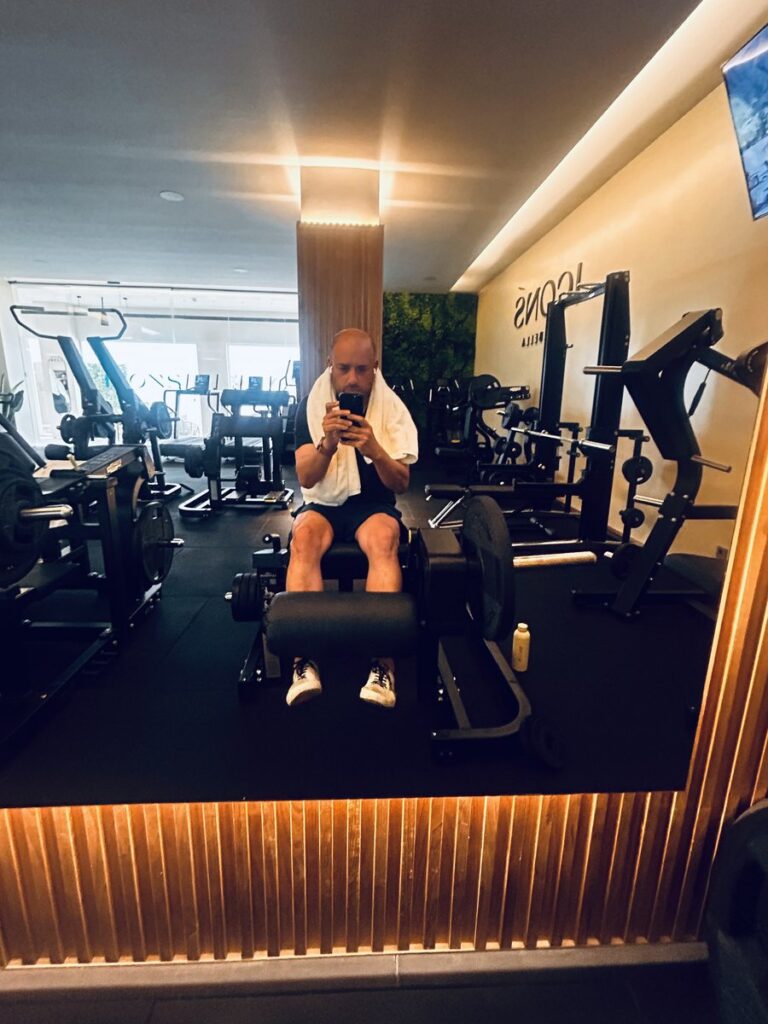
It all began at Cesiones Icons Gym in Marbella. If you know Marbella, you know it’s not exactly a city that makes you feel like you need to take it easy. There’s energy in the air there. Sun, sea, people moving, people living loud. But underneath all of that, I was not okay. I was pushing through days feeling like something was off — not dramatically, not in a way that was easy to point to, but in that quiet, persistent way your body has of telling you that things need to shift.
My doctor had conversations with me that I kept half-listening to. Not because I didn’t care, but because I think part of me wasn’t ready to hear it. Training needed to become a health decision, not just something I did when I felt like it. I needed to learn what “safe margins” actually meant for my body. Not someone else’s. Mine.
The hardest part isn’t the training. It’s starting.
I want to be honest about this because I think too many people gloss over it. The gap between deciding to change and actually starting is enormous. It is a canyon. And the thing nobody tells you is that starting when you’re not at your best — when your energy is low, when you’re not sure your body can keep up, when you feel uncertain — that is the hardest version of starting. That’s what I did on 30 April.
But here’s the real story. It wasn’t some quiet, solo epiphany. It was my partner.
She is younger than me. Stunning. And fit — genuinely, properly fit — in that way that makes you realise you’ve been coasting on the idea of yourself rather than the reality. For a while I told myself I could stay the old me. That it was fine. That who I was, was enough. I wasn’t ready to look at the gap between who I was and who I could be.
She pushed me. And I mean that in every sense of the word. It wasn’t just the gym. It wasn’t just “you should exercise more.” It was everything. The hair. She pushed me to shave it — all of it — and I resisted that too, the way I resisted everything at first. Because when someone who loves you starts pushing you toward a better version of yourself, it can feel, in the thick of it, like criticism. Like you’re not enough. It took me a while to understand that’s not what it was at all. It was the opposite. It was someone who could see clearly what I couldn’t — or wouldn’t — see.
“She wasn’t pushing me away from who I was. She was pulling me toward who I could be.”
The “you need to, you need to, I want you to be healthy” — I heard it so many times I started to go numb to it. Not because I didn’t care. Because I cared too much and didn’t know what to do with that. Changing felt enormous. Changing felt like admitting something. And I am, it turns out, spectacularly good at not admitting things.
And then one day, I cracked. Not in a dramatic, door-slamming way. More like the quiet collapse of someone who has been holding a position for too long and finally, mercifully, runs out of the energy to keep holding it. I stopped arguing. I shaved my head. I went to the dentist — actually went, and started fixing my teeth, which had been on my mental list of “someday” for longer than I want to admit. I put on my trainers and walked into Cesiones Icons Gym in Marbella.
That was 30 April. And every single one of those changes — the hair, the teeth, the training — happened around the same time, in this overlapping, messy, beautiful avalanche of transformation. I didn’t plan it that way. I think once you allow one wall to come down, the others follow faster than you expect.
I look at photos from before and I don’t recognise the person in the same way I used to. Not because I look so dramatically different — although I do — but because the person in those photos was still pretending. Still holding out. The person writing this is not.
It was, without question, the best change I have ever made in my life. And I would not have made it without her.
Training within safe margins meant I had to check my ego every single time I walked through that door. I’m someone who, historically, has the tendency to go too hard too fast and then wonder why I’m broken for a week. The whole point of this change was to find a rhythm I could actually sustain — to build consistency instead of intensity. It meant working with my heart rate. Paying attention to recovery. Asking “is this helping or hurting?” in a way I never used to.
Cesiones Icons became my anchor. The people there, the space, the routine of it — that mattered. But I also knew that my life was going to keep moving. And it did.
Now I’m in the USA — and I’m still going.
A few weeks in, everything shifted geographically. I found myself in the United States. New country, new gyms, new streets to run, new everything. And you know what I discovered? That the work I’d done in Marbella had actually stuck.
This is the part I want to underline for anyone reading who thinks they’ll “restart” when life settles down: life doesn’t settle down. There is no perfect moment. The routine you build has to be resilient enough to travel with you. Mine did. Not without friction — finding a new gym is annoying, new schedules take adjusting to — but the habit was there. The foundation held.
30
APRIL
DAY 1
MARBELLA
Sept
KILIMANJARO
Training in the USA has its own flavour. People here take their fitness seriously — sometimes to a level that still surprises me — and there’s a culture of just showing up and getting it done that I’ve found genuinely motivating. I’ve also had to keep reminding myself of the safe margins principle. Because it’s easy, in a new environment, surrounded by energy and possibility, to push past what your body is actually ready for. Easy to forget why you started doing this more carefully in the first place.
And then there’s Craig.
Craig is my trainer. And Craig texts me. A lot. Some days it genuinely feels like a thousand times. It’ll be some random hour and my phone buzzes and it’s him: “Mate, good work. Now for more.” Or a check-in on my eating. Or a reminder to keep my sleep up. Short messages, punchy, relentless in the best possible way. Like having a little bug permanently installed in your ear — except the bug knows exactly what it’s talking about and genuinely cares whether you show up tomorrow.
I’ll be honest — there are moments I look at my phone and just laugh. Because the consistency of it is almost absurd. But here’s the thing: it works. Knowing that someone is actually tracking your effort, actually paying attention, actually going to notice if you go quiet — that changes something. You’re not just accountable to yourself anymore. And when you’re thousands of miles from where you started, in a new country, with every easy excuse available to you, that little buzz from Craig is the thread that keeps it all connected.
“Good work. Now for more.” Three words that somehow never get old.
Sleep, eating, training — he treats them as one system, not three separate things you deal with when you feel like it. You can’t out-train bad sleep. You can’t ignore what you eat and expect your body to perform. It sounds obvious written down. It wasn’t obvious to me before Craig made it impossible to ignore.
But I haven’t forgotten why I’m here. Because now there’s a new goal. A big one…
NEXT CHAPTER
Kilimanjaro. September 2025.
When I tell people I’m preparing to climb Kilimanjaro, I get one of two reactions. Either genuine excitement, or that polite, wide-eyed look that means “are you sure about that?” And honestly? Both reactions make sense. Kilimanjaro is 5,895 metres above sea level. It is the highest mountain in Africa. It is not a casual hike. And I will be standing at the top of it in September.
The physical training is one thing. I’m building up my cardio, doing longer walks with a loaded pack, working on strength and endurance. All of it within the safe margins that have become my non-negotiable way of working. But what I’ve been researching — and what I’ve been spending a lot of time thinking about — is the mental side of this.
The mountain is mostly in your head.
I know that sounds like a poster you’d find in a dentist’s waiting room. But the more I read, the more I talk to people who’ve done it, the more I believe it’s simply true. Many climbers who don’t reach the summit aren’t stopped by their legs. They’re stopped by their minds. That fact stopped me cold when I first read it. Because it means the work happening right now — every early morning, every session where I don’t feel like it, every moment of choosing consistency over comfort — that work is as much mental training as it is physical.
“You don’t need to be the fastest or the fittest to reach the top. You need to be resilient, patient, and focused.”
Summit night on Kilimanjaro starts at midnight. You hike for six to eight hours in freezing cold, in the dark, at altitude, while your body is running on very little sleep and very thin air. At that point, your legs may be capable of continuing long after your mind has started negotiating an exit. The preparation I’m doing now — training through discomfort, learning to distinguish between “this is hard” and “this is actually harmful,” staying calm when things feel harder than expected — all of that is directly applicable to that night.
WHAT I’VE LEARNED ABOUT MENTAL PREP
Know your “why.” Not the Instagram version — the real reason. Write it down. Revisit it on the days it feels pointless. The Swahili phrase for the Kilimanjaro approach is pole pole — slowly, slowly. It’s not just a pacing strategy. It’s a mindset. Accept that the mountain won’t be rushed. Accept that discomfort is part of the journey, not a sign something’s gone wrong. Prepare for the hard parts by expecting them, not by hoping they won’t come.
I’ve started doing something called mental rehearsal. I know it sounds a bit woo, but it’s genuinely backed by sports psychology. I close my eyes and walk through it: the camp at 2am, the cold, the headlamp on the trail in front of me, the altitude headache I’ll probably have, the voice in my head that will be absolutely certain I should turn around. And I see myself moving through it. Not breezing through it. Moving through it.
I also sit with my “why” regularly. My reason for climbing Kilimanjaro is personal, layered — it’s connected to the same health conversation that first brought me to Cesiones Icons in Marbella. Proving to myself that a body I was once worried about can do something extraordinary. That’s the anchor. When summit night gets hard, that’s where I’ll come back to.
What starting actually taught me.
If you take one thing from this, let it be this: the most important moment isn’t the summit. It isn’t even the halfway point. It’s the decision to begin, and then the quiet, unglamorous act of doing it again the next day. Everything else is built on that.
I started on 30 April. Not because conditions were perfect. Not because I felt ready. Because I knew that if I waited to feel ready, I would be waiting for something that wasn’t going to come. And so I went to a gym in Marbella and I started.
Now I’m in the USA, keeping the streak alive, adapting, adjusting, and pointing everything toward a mountain in Tanzania. The goal is almost laughably big compared to where I started. That’s kind of the point.
I’ll write again from the mountain.